About
Expedition PolarVR
will work with rural librarians, bilingual science communicators, polar scientists and a technical team to create a series of five bilingual virtual reality (VR) experiences, engaging users as polar explorers of exotic and extreme environments to enhance STEM understanding and appreciation. The project will create a new channel for disseminating polar science, working first with underserved rural Latinx communities in Wisconsin to create a new network between rural communities and university researchers. Involving rural librarians in the co-design process will produce new ways for rural libraries to engage their local communities and their growing Latinx populations with polar science learning experiences. Each of the five VR experiences will focus on a different area of research, using the captivating Arctic and Antarctic environments as a central theme to convey science. VR is a particularly powerful and apt approach, making it possible to visit places that most cannot experience first-hand while also learning about the wide-range of significant research taking place in polar regions. After design, prototyping and testing are finished, the VR experiences will be freely available for use nationally in both rural and urban settings.
The project has developed four free VR experiences:
Waddle: A Penguin’s Tale (Penguin VR), Exploring the Universe from Antarctica,On The Ice: Weather Station, and On The Ice: Hatched
Waddle: A Penguin’s Tale

Waddle: A Penguin’s Tale replicates the Antarctic environment of the Adelie penguins into a fun, task filled virtual reality space. The game’s intention is to promote curiosity and understanding about the Antarctic by getting users to feel like they are truly within the body of a penguin.
Exploring the Universe from Antarctica
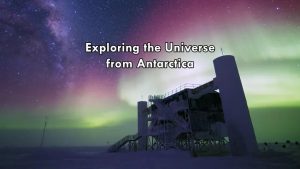
Exploring the Universe from Antarctica is about the IceCube Neutrino Observatory, which has been collecting a huge amount of data about neutrino and water molecule interactions deep in the Antarctic ice. The IceCube Program is headquartered at UW-Madison and its science is run by an international collaboration of more than 300 scientists aiming to learn more about the extreme universe by using high-energy neutrinos.